Discover how we are bringing curriculum-aligned maths practice to Welsh-medium learners through a rigorous translation process that honours both language and learning.
Why Welsh-Medium Maths Resources Matter More Than Ever
For Welsh-medium schools and bilingual learners, access to high-quality, curriculum-aligned resources in their first language isn't just preferable, it's essential. When children can engage with maths in Welsh, they're able to focus their cognitive energy on understanding mathematical concepts rather than navigating language barriers. This is particularly important for building confidence and fluency in the early years, where foundational understanding shapes attitudes towards maths that last a lifetime.
The Curriculum for Wales places a strong emphasis on inclusion, progression, and supporting learners to develop as confident, capable individuals. Welsh-medium digital resources play a vital role in that vision, ensuring every child can access engaging, adaptive practice that meets them at their level. Yet historically, high-quality EdTech platforms have often been available primarily in English, leaving Welsh-speaking pupils and teachers with limited options.
That's why we're working to translate all of Sumdog Maths content for Years 1–6 into Welsh, ready for the new school year in September. This isn't a surface-level translation project, it's a carefully managed, multi-stage process designed to ensure the language feels natural, the terminology is accurate, and the experience is truly inclusive. We're collaborating closely with Welsh-speaking teachers, language specialists, and developers to get it right.
Building the Foundation with Subject Matter Expertise
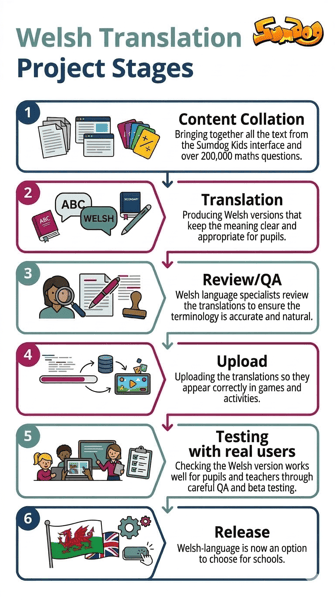
Every successful translation project begins with understanding what needs to be translated and in the case of Sumdog Maths, that's no small task. Our project manager, Rhidian James, is leading the effort to collate all the text from the platform, including the pupil-facing interface and over 200,000 maths questions. This content collation stage is about more than simply gathering words, it's about understanding context, tone, and how language is used across games, activities, and instructional prompts.
Maths questions aren't just strings of text. They rely on precise wording to convey meaning clearly, especially when pupils are working independently. A question about fractions, for example, must be worded in a way that feels familiar and accessible to a seven-year-old in a Welsh-medium classroom. That requires not only linguistic accuracy but also pedagogical awareness, understanding how teachers introduce concepts and the vocabulary pupils are likely to encounter in their everyday learning.
By working with Welsh-speaking teachers from the outset, we're able to ensure that the terminology we use aligns with what's being taught in real classrooms. This collaboration between educators, language specialists, and our development team is at the heart of the project. It's what transforms a translation from technically correct to genuinely effective.
Ensuring Mathematical Accuracy Across Languages
Once the content has been collated, the translation stage begins. This is where Welsh language professionals produce versions of every question, instruction, and piece of feedback that keep the meaning clear and appropriate for primary-aged pupils. Translating educational content is a specialist skill, it's not just about linguistic equivalence, but about preserving the intent, tone, and accessibility of the original.
Mathematical language can be particularly challenging. Terms like 'difference', 'product', and 'sum' have specific meanings in a maths context that differ from everyday usage. In Welsh, it's essential that these terms are both mathematically accurate and pedagogically appropriate, reflecting the language teachers use and the expectations set out in the Curriculum for Wales. Our translators work closely with subject matter experts to ensure nothing is lost in translation.
Following translation, every piece of content enters a rigorous review and quality assurance stage. Welsh language specialists carefully review the translations to ensure terminology is accurate, natural, and consistent across the platform. This stage is critical. It's where we catch subtle issues that could confuse learners or feel awkward in a classroom setting. We're not just checking for correctness; we're checking for clarity, accessibility, and authenticity.
Testing for Clarity and Accessibility in Real Classrooms
Once translations have been reviewed and approved, the next stage is upload. This technical process involves integrating the Welsh-language content into the platform so it appears correctly across all games, activities, and reports. It's a detailed, developer-led stage that ensures the translated content works seamlessly within the adaptive learning experience Sumdog is known for, without introducing bugs or inconsistencies.
But translation work doesn't end when the content goes live. The testing stage is where we check that everything works as it should for both pupils and teachers. This involves careful internal quality assurance, followed by beta testing with real Welsh-speaking pupils and educators. We want to understand how the language feels in practice: Is it engaging? Does it feel natural? Are there any terms or phrasings that trip pupils up or feel unfamiliar?
This stage is invaluable. Teachers know their pupils best, and their feedback helps us refine the experience before the full release. It's another layer of collaboration that strengthens the final product and ensures we're delivering something that truly serves Welsh-medium learners. Testing in real classroom environments means we can identify and resolve issues early, so that when Sumdog Maths launches in Welsh this September, it's ready to support learning from day one. To see how Sumdog has already made a measurable difference in a Welsh primary school, read about the impact study at Ysgol Bro Carmel.
Supporting Welsh Schools with Trusted, Inclusive Practice
The final stage is release. The moment when Welsh becomes an option that schools can choose within Sumdog Maths. From September, Welsh-medium schools will be able to offer their pupils engaging, adaptive maths practice in their first language, with all the benefits of personalisation, motivation, and insight that Sumdog provides. For teachers, it means less time searching for suitable resources and more time focusing on what matters: supporting every child to make progress.
What makes this project meaningful isn't just the scale, though translating over 200,000 questions is no small feat, it's the care and collaboration behind it. This is a genuinely multi-stage process, involving teachers who understand the realities of Welsh-medium classrooms, language specialists who bring expertise in educational terminology, and developers who ensure the platform works flawlessly. Every stage is designed to honour both the Welsh language and the learning experience.
We know that access to high-quality, inclusive resources makes a real difference. When pupils can learn in the language they're most comfortable with, they're more confident, more engaged, and more likely to succeed. That's what drives this work and it's why we're proud to be bringing Sumdog Maths to Welsh-speaking learners this autumn. We're looking forward to supporting schools across Wales as they help every child build fluency, confidence, and a positive relationship with maths.