
Sumdog Impact Report September 2025
- Chapter 1: Executive Summary
- Chapter 2: Introduction
- Chapter 3: Methodology
- Chapter 4: How is Sumdog used by teachers?
- Chapter 5: What are the early findings on Sumdog's impact on pupils' attitude towards maths?
- Chapter 6: To what extent does using Sumdog impact pupils' attainment in maths?
- Chapter 7: Is there any differential impact on pupils eligible for Pupil Premium or with SEN status?
- Chapter 8: According to teachers, were there any pros and cons to using Sumdog?
- Chapter 9: Summary and Next Steps
Executive Summary
Sumdog is a maths practice platform through which children learn by answering curriculum-aligned questions integrated into fun gameplay. At the same time, pupils’ teachers can monitor performance to identify gaps and plan next steps.
This impact report is based on attainment and survey data from 499 and 239 pupils respectively across 14 schools. It is also based on interviews and focus groups conducted with 15 teachers from 11 different schools. The primary qualitative analysis was conducted based on focus groups with 13 teachers from 9 different schools, as the remaining two teachers had not engaged sufficiently with the platform.
The main findings from the report can be found below:
- Easy to use. Overall, teachers explained that after the initial induction and setting up, they and their pupils didn’t need further help.
- Use cases for teachers. Teachers used Sumdog as a tool for pupils to practise what they had been taught in class, engaged less interested pupils with learning maths and to identify gaps in learning.
- Enjoyment vs. Attitude shift. While there is consensus among teachers that pupils enjoy engaging with maths through Sumdog, pupil survey findings suggest that this enjoyment does not necessarily translate into a broader change in their overall attitudes towards the subject. However, some teachers expressed optimism that attitudinal shifts may emerge over a longer period.
- Attainment trends. Pupils using Sumdog showed statistically significant improvements in maths attainment between Term 1 and Term 3. However, without a comparison group, no causal claims can be made. Teachers felt Sumdog supported mathematical fluency and was a valuable component of their teacher toolkit for improving progress.
- Impact on male pupils. Male pupils saw a statistically significant decrease in their anxiety towards maths (-5.5 percentage points) and a statistically significant improvement in their maths attainment between Term 1 and Term 3, while female pupils did not. These findings suggest that gender may play a role in how pupils engage with and respond to the platform.
- Promoting mathematical accuracy. A feature recently introduced by Sumdog – prompting pupils to slow down when answering questions – appears to be effective in encouraging pupils to apply their mathematical understanding more carefully when answering questions.
-
Support for vulnerable learners. Pupils with SEN (Special Educational Needs), lower-attaining pupils and pupils with lower self-esteem were the ones mostly benefiting from the use of Sumdog.
Introduction
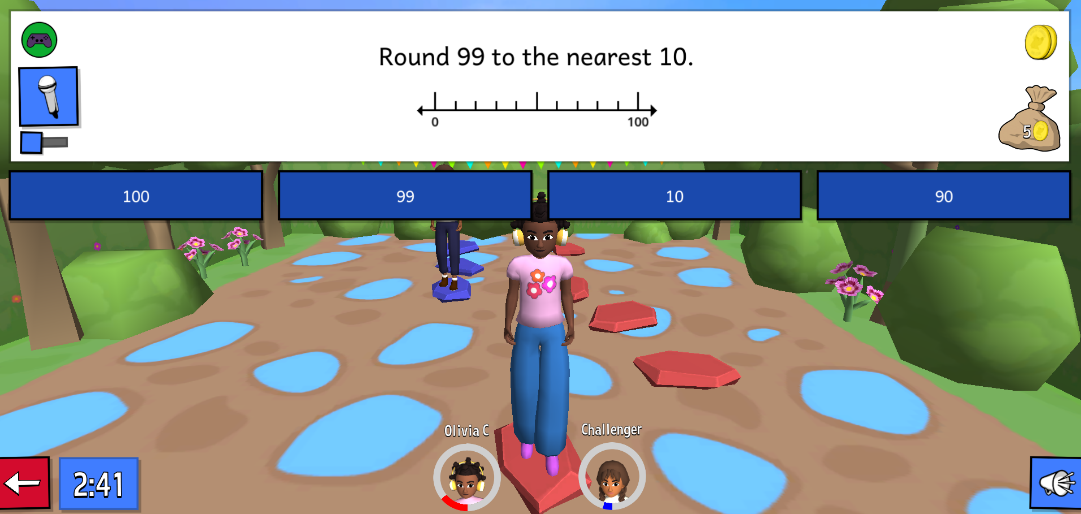
Sumdog is an adaptive learning platform for children aged 5 to 14 years old with a range of tasks aiming to help them learn and practise maths across the full primary curriculum. On Sumdog, pupils are entertained while they learn through answering curriculum-aligned questions integrated into 38 single and multi-player games (Figure 1).

Figure 1. Student - Balloon Ride game
Sumdog helps teachers revise and consolidate previously taught concepts and monitor performance to identify gaps and plan next steps. Teachers can set practice to be completed during gameplay or use diagnostic and low-stakes tests to assess children’s progress through Sumdog. Teachers can view results in real-time with an easy-to-interpret class overview (Figure 2).
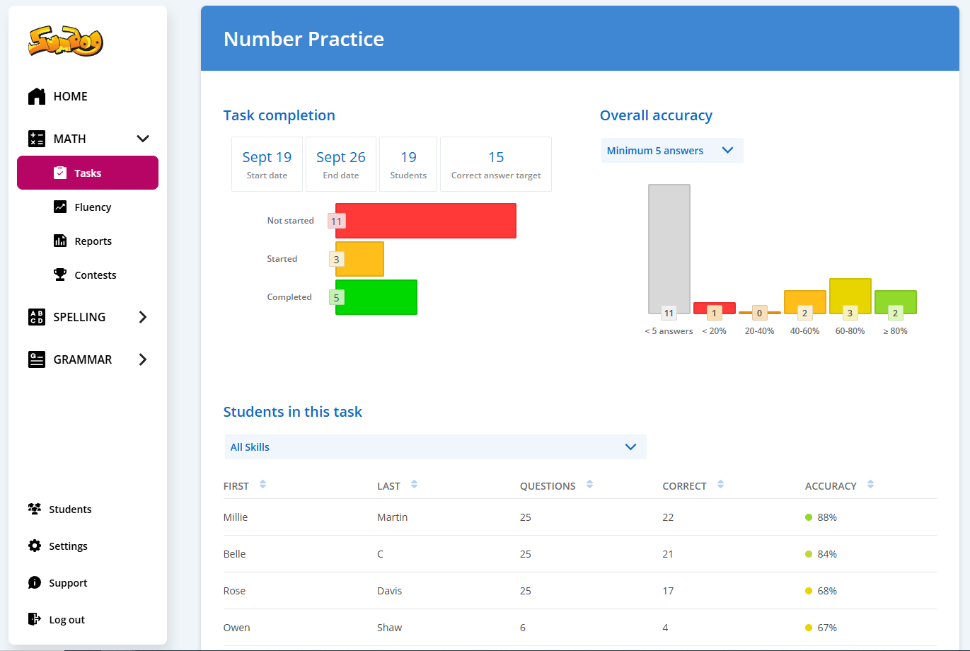
Figure 2. Teacher - Number Practice results
This academic year 2024-25, Sumdog has partnered with ImpactEd Evaluation to a) investigate how Sumdog has been used by teachers and find opportunities to further improve the platform and b) understand the impact of Sumdog on Year 5 pupils’ maths attainment and attitude towards maths.
This impact report is based on data collected from 14 schools using Sumdog for the first time from October 2024 to June 2025. More specifically attainment data was collected from 499 pupils and survey data was collected from 239 pupils respectively. Interviews and focus groups were also conducted with 15 teachers from 11 different schools. The primary qualitative analysis was conducted based on focus groups with 13 teachers from 9 different schools, as the remaining two had not engaged sufficiently with the platform.
Methodology
3.1 Research Questions
Below are the research questions this impact report aims to answer.
- How was Sumdog implemented in schools and what elements did and did not work well according to teachers of Year 5 pupils?
- What are the early findings on Sumdog's impact on Year 5 pupils' attitudes towards maths?
- To what extent does using Sumdog impact Year 5 pupils' attainment in maths?
- Is there any differential impact on pupils of different genders, eligible for PP or with SEN status?
3.2 Design, Sample and Anaylsis
Design
To investigate the aforementioned research questions, we used a combination of teacher interviews and focus groups, school templates for maths attainment data collection and pupil surveys. The table below outlines which outcome each of the data collection tools intended to measure (Table 1).
|
Outcomes measured |
Teacher interviews & focus groups |
Maths attainment data collection |
Pupil surveys |
|
Implementation of Sumdog |
|
- |
- |
|
Pupils’ attitudes towards maths |
|
- |
|
|
Pupils’ attainment |
|
|
- |
|
Pupil subgroup differences |
|
|
|
Table 1: Data collection tools used to measure each outcome.
Fourteen (14) schools constitute the sample participating in Sumdog’s wider evaluation for this academic year (2024-25). These schools have agreed to collect surveys and attainment data for pupils in Year 5, as well as participating in focus groups in January or June 2025. To recognise teachers’ time and effort, the schools have been offered a two-year subscription to Sumdog for free in return. Teachers from 5 different schools participated in this first round of focus groups.
The interviews and focus groups were semi-structured. A semi-structured format means that the interview guide includes questions or issues to be asked about, but the moderator does not necessarily need to stick with the exact wording. It also includes a variety of ‘probe’ questions. While the moderator is expected to steer the conversation in the intended direction, the participants are largely free to explore different topics.
To more explicitly measure pupils’ attitudes towards maths, the survey assessed four key areas: 1) confidence in maths, 2) motivation to learn maths, 3) perceived capability in maths, and 4) anxiety related to maths. The four measures were custom-designed to align with Sumdog’s intended outcomes.
The ‘Confidence in maths’ survey has been adapted to reflect maths-specific self-efficacy from the Motivated Strategies for Learning Questionnaire (MSLQ).The other three surveys (‘Motivation to learn maths’, ‘Perceived capability in maths’ and ‘Anxiety in maths’), have been adapted from the Cambridge 25-item questionnaire for secondary school pupils
Qualitative sample
Five one-to-one interviews and five focus groups (with two participants each) were conducted with teachers to share their experience of using Sumdog. The interviews’ length varied depending on the number of participants and the length of their experience of using Sumdog. As a result, interviews were conducted with 15 teachers. Table 3 below presents more information about the set-ups for the interviews and the roles of teachers, most of whom were class teachers in Year 5 (Table 3).
|
Rounds |
Focus group / Interview |
Teacher |
Role |
School |
|
Round 1 (January) |
Focus group 1 |
Teacher 1 |
Year 5 Teacher |
School A |
|
Teacher 2 |
Year 5 Teacher |
|||
|
Interview 1 |
Teacher 3 |
Year 5 Teacher |
School B |
|
|
Focus group 2 |
Teacher 4 |
Subject lead for maths, Year 4 Teacher |
School C |
|
|
Teacher 5 |
Headteacher, Maths lead, Year 1-6 Teacher |
School D |
||
|
Interview 2 |
Teacher 6 |
Year 5 Teacher |
School E |
|
|
Round 2 (June) |
Interview 3 |
Teacher 7 |
Deputy Headteacher, SENco |
School F |
|
Focus group 3 |
Teacher 8 |
Assistant Headteacher |
School G |
|
|
Teacher 9 |
Maths lead, Year 5 Teacher |
|||
|
Focus group 4 |
Teacher 10 |
Year 5 & 6 Teacher |
School H |
|
|
Teacher 11 |
Year 5 Teacher |
School I |
||
|
Focus group 5 |
Teacher 12 |
Year 5 & 6 Teacher, Maths Lead |
School J |
|
|
Teacher 13 |
Year 4 Teacher |
|||
|
Interview 4 |
Teacher 14 |
Maths Lead |
School K |
|
|
Interview 5 |
Teacher 15 |
Supply Year 5 Teacher |
||
|
2 Rounds |
5 focus groups & 5 interviews |
15 teachers |
N/A |
11 schools |
Table 2: Data collection tools used to measure each outcome.
Although the focus was on Year 5 pupils, two Year 4 teachers were also invited to share their experiences of using Sumdog.
Quantitative sample
In terms of the quantitative sample, 499 pupils’ maths attainment data was collected (Table 3). This was teacher-assessed data of ‘Working Below Expected Standard’, ‘Working At Expected Standard’ or ‘Working Above Expected Standard’ in Term 1 and 3. Of those pupils, about half were female and half were male. Also, 32.5% of the pupils had Pupil Premium funding and 22.1% had SEN.
A total of 239 pupils completed both baseline and endline surveys during the 2024–25 academic year. The table below presents the number of matched pupil responses for each outcome measured. While pupils were not asked directly about their Pupil Premium (PP) status or Special Educational Needs (SEN), gender data was collected, showing that 47.6% of respondents were female.
|
Number of matched maths attainment |
Number of matched pupil surveys |
|||||
|
Subgroups |
Confidence in maths |
Capability in maths |
Motivation in maths |
Anxiety in maths |
||
|
Overarching |
All participating |
499 |
239 |
212 |
202 |
239 |
|
PP |
No PP funding |
337 |
- |
- |
- |
- |
|
PP funding |
162 |
- |
- |
- |
- |
|
|
SEN* |
No SEN |
388 |
- |
- |
- |
- |
|
SEN |
110 |
- |
- |
- |
- |
|
|
Gender |
Female |
246 |
124 |
107 |
103 |
124 |
|
Male |
253 |
114 |
104 |
98 |
114 |
|
|
*There was no data for one of the pupils on their SEN details. |
||||||
Table 3: Quantitative sample for attainment data and pupil surveys.
Qualitative data analysis
The qualitative data was analysed using a deductive thematic approach, meaning that we systematically ‘coded’ the data based on the research questions to find common themes and then presented these, drawing on examples where appropriate.
Teachers 1 and 2 from School A raised during their interview that their school was having technical issues using Sumdog. As a result, the school was excluded from further qualitative analysis as they hadn’t had a chance to engage sufficiently with the platform. The Sumdog Support Team and Account Manager worked with the school to resolve the issue which impacted their Year 5 devices due to restrictions in place on their browser network. Other Year groups within the school were able to access.
The remainder of the report explores the other teachers’ experience of using Sumdog and its impact on their Year 5 pupils.
Quantitative data analysis
The pupil surveys were analysed by averaging pupils’ scores at baseline and at endline and exploring the percentage point change over time. Statistical significance testing was conducted using paired t-tests and Wilcoxon Sign-rank tests. Subgroup analysis was also conducted to investigate the differential impact of Sumdog on pupils with and without Pupil Premium (PP), Special Educational Needs (SEN) and by gender.
Pupils’ maths attainment was analysed using frequency distributions at baseline and endline. We also used chi-squared tests to explore whether the changes observed between baseline and endline grades were statistically significant.
3.3 Limitations
- The pupil surveys have not been validated. The pupil surveys were custom-designed to align with Sumdog’s intended outcomes, but the measures have not been formally validated. As such, there is a risk that the surveys may not accurately capture the constructs they aim to assess.
- Lack of a comparison group. The evaluation did not include a control or comparison group for maths attainment or pupil survey data. This limits the ability to draw causal conclusions about Sumdog’s impact. Future evaluations could consider tracking these pupils into Key Stage 2 and comparing their SATs results in maths to national averages.
-
Limited pupil voice. While the evaluation captures some insights into pupil experience, pupil engagement and enjoyment of Sumdog were not explored from the pupils’ perspective. Including pupil interviews in future phases would provide richer, first-hand perspectives on their relationship with Sumdog and with maths more broadly.
How is Sumdog used by teachers?
During the interviews, teachers referred to a variety of ways in which they used Sumdog to enhance pupils’ learning. The main three use cases are:
- a way for pupils to practise what they had been taught in class,
- a way of engaging the less interested pupils with learning maths and
- a way for teachers to identify pupils’ gaps.
4.1 Sumdog as a consolidation activity for practising what pupils learn in class.
Teachers mentioned that they used Sumdog for encouraging pupils to practise what they had learned and revise in school and at home. For example, one of the teachers explained how after their pupils had finished with their work in class they would go on Sumdog in order to consolidate their knowledge:
“We found it very useful…for children to extend their learning in class after they've done their main inputs, but also as a revision activity at the end of the week to show what they've done, what they've learnt and to practise it independently at a level that's appropriate to those children.”
Teacher 5
Maths Lead & Year 1 - 6 Teacher
Sumdog was often referred to as “something fun that can aid them [pupils] with their practice” (Teacher 13, year 4 teacher). For example, Teacher 15 explained that while pupils are playing on Sumdog during class time, they will work their way through the rows of the class overseeing how the pupils are doing and helping them answer the questions correctly:
“Because my classroom has 4 rolls of tables, so I'll start from the front and then I'll ask them, OK, what are you doing?...sometimes I'll ask them, oh, there's a question here. So what does this mean?...And they're like, oh, it's ‘A’. And I go, how do you know it's ‘A’? Then sometimes we'll have a paper in front of them and they'll work it out. And I'm like, ‘exactly’. Done. Fantastic. So then they press A”
Teacher 15
Supply Year 5 Teacher
“So we often use it as an extension…and we also set it as homework, weekly homework so children can practise what they've learned at home. So we set the tasks that are relating to the subjects that either they've done or are going to come up as well. So they can get like a pre-teach of what's going on in their math lesson coming up.”
Teacher 3
Year 5 Teacher
Overall, teachers described Sumdog as a great tool for pupils to practise what they learned in class.
4.2 Sumdog as a way to engage pupils with learning maths.
Additionally, teachers unanimously talked about using Sumdog as a ‘foot in the door’ in engaging pupils with maths. They used it as an addition of ‘fun’ to the traditional maths lessons. For example, a teacher talked about asking pupils to go on Sumdog towards the end of each maths lesson:
“In my class, once the children have finished the lesson, I do the [Sumdog] task for that lesson on the same day. So they're able to answer…the questions and they have a little bit of fun.”
Teacher 3
Year 5 Teacher
Key Finding: School D
Teacher 5 commented that for many of their least interested pupils in maths, Sumdog was a good way of getting them engaged through gamified exercises where there was less pressure on answering the questions correctly.
Similarly, another teacher explained that they used Sumdog as a tool for pupils who found it hard to complete the core work. Using Sumdog was a way to continue learning within the lesson instead of giving up on trying:
“If the children have finished their [lesson] work…we know that some children will find it hard just to get through to do it. So if they've done it, I'm like…you go on to Sumdog now and try and consolidate your knowledge more that way because I know that then that excites them to actually be doing something else other than work in their books or anything like that…”
Teacher 6
Year 5 Teacher
4.3 Sumdog as a way of investigating pupils' learning gaps and needs
Teachers suggested that Sumdog could be used for identifying both the entire cohort’s needs as well as individual pupils’ needs. Interestingly, teachers from both smaller and from larger schools mentioned that through Sumdog they were able to efficiently spot pupils’ learning gaps and inform their teaching based on them.
One teacher mentioned how, because they were teaching in a small school, they taught maths to all of the pupils from Year 1-6 in the school and were able to adjust the difficulty of the exercises for pupils based on their scores on Sumdog:
“I guess in my case I'm very lucky to have so few pupils here…it enables me to do that [identify pupils’ needs] very quickly myself, and to set it [Sumdog exercises] appropriately for the children.”
Teacher 5
Year 1 - 6 Teacher
“As a teacher…to actually go. Right? Well, I want to see how this student is performing [and I] can find that instantly.”
Teacher 8
Assistant Headteacher
Figure 3 below depicts a test report that teachers can use to identify gaps and plan next steps.
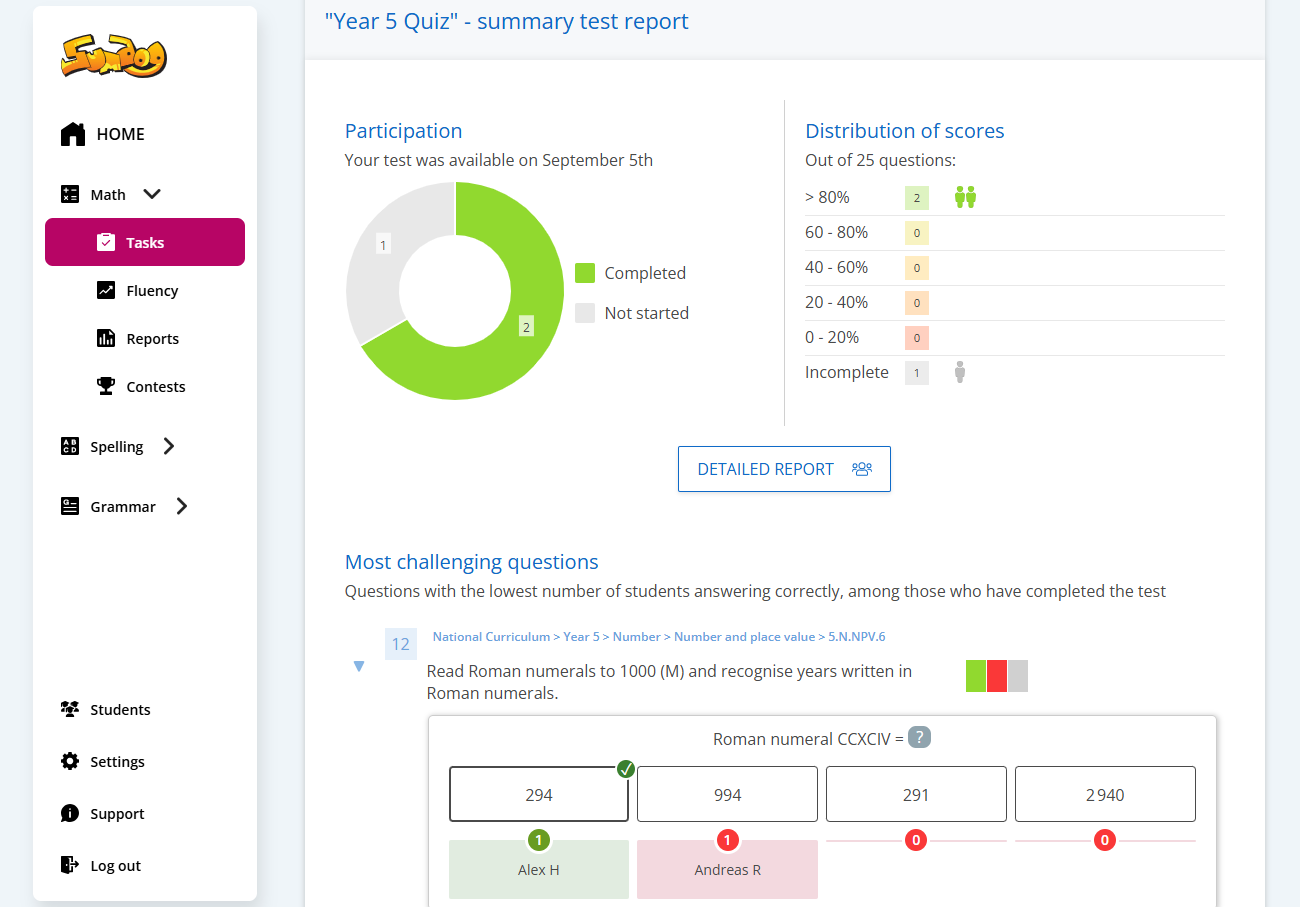
Figure 3. Teacher - Year 5 Quiz test report
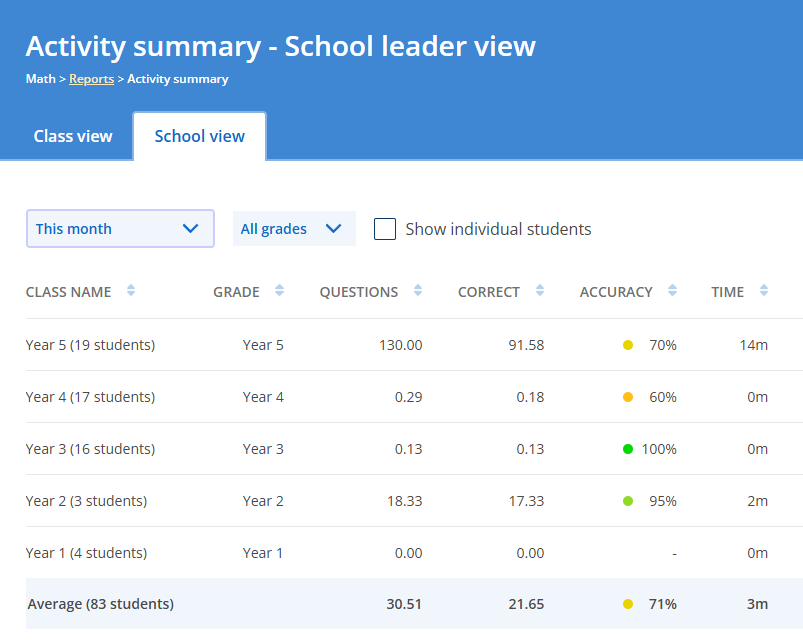
Contrarily, another teacher who was subject lead for maths in their school, but was not teaching Year 5 (which is the pupil sample targeted in this evaluation) described a different reality. In their school. They find it challenging to look into each individual pupil’s gaps due to the large number of pupils, but as a subject lead for maths they were able to identify the pupils’ gaps at a year group level (Figure 4):
“I'm doing all the management of it. I would foresee in the future as we roll it out, greater attention from the class teachers to the feedback it provides about individual users and their areas for development. But at the moment we're looking at it as a whole year group.”
Teacher 4
Maths Lead

Figure 4. Sumdog Activity Summary – School leader view
It is worth noting that the teacher expressed their expectation of class teachers eventually looking at individual pupils’ areas for development. The same teacher also explained that despite not intentionally looking at pupils’ scores at an individual level, it was easy to distinguish the pupils that understood from those that didn’t based on the information shown on the Sumdog platform:
“It definitely is clear where I've set something that they should have been doing in class and those that have understood and those that haven't.”
Teacher 4
Maths Lead
Other teachers were already using Sumdog to identify individual pupils’ needs and adjust their teaching accordingly. For example, a supply teacher explained that the Maths Lead regularly reviewed pupils’ activity data – such as whether they completed tasks at home and which areas they struggled with – and shared these insights with them. This allowed the supply teacher to follow up with pupils who didn’t complete activities, understand their reasons, and adjust support accordingly.
“The maths lead…has access to all those times when they do it at home or when they don't do it and where the gaps are. So she does let me know oh some of these [pupils] did it at home. These are not the ones that we chase…up. So I'm like OK why didn't you do it at home? So they tell me the reasons…The ones that do it at home. Oh, their strengths are this, but their weaknesses are this. So we need to focus more on that. So we do.”
Teacher 15
Supply Year 5 Teacher
A Year 5 teacher also highlighted how pupils are using Sumdog to reflect on their own learning and identify areas they want to improve, such as fractions. It shows that some pupils are becoming more proactive in their learning by requesting additional support or practice on specific topics they find challenging through the use of Sumdog.
“Can we do a bit of work, some of them quite often will say, oh, I don't get the fractions. Can we do some fractions work or I can have another go [at Sumdog test] and get it right next time.”
Teacher 11
Year 5 Teacher
Finally, another Year 5 teacher described how Sumdog’s diagnostic testing enabled identifying and filling in pupils’ gaps without teachers needing to adjust the exercises manually:
“And it actually helps because when they've done their diagnostic testing, what comes up on there is the aspects that they need help with so they can go on and do the tasks on there that it sets for them based on what their diagnostic testing said about that individual child.”
Teacher 6
Year 5 Teacher
Overall, teachers found a variety of uses for the Sumdog platform. They primarily used it as a tool to practise previously taught maths skills in class but also at home. Due to its element of gamified maths exercises, many teachers were also able to engage those pupils that would usually be the least likely to engage. Finally, they were able to identify pupils’ gaps at a year group level, but also at an individual-level for classroom teachers engaging with the platform.
What are early findings on Sumdog's impact on pupils' attitudes towards maths?
Most teachers noted that it was too early in the implementation of Sumdog to accurately assess its overall impact. This sentiment was echoed by teachers in both Round 1 (January) and Round 2 (June) of focus groups. However, many had already observed positive effects on pupils’ engagement with maths, highlighting increased enjoyment of the exercises and growing confidence when using the platform.
The prevailing view was that, while Sumdog successfully supports learning and boosts engagement, it does not necessarily shift pupils’ broader attitudes toward maths as a subject. Teachers recognised that their goal isn’t always to make every child love maths, but rather to ensure that even those who struggle don’t disengage from it entirely.
Consistent with this view, quantitative data from pupil surveys showed no statistically significant change between baseline and endline timepoints in pupils’ confidence, motivation, perceived capability in maths, or levels of maths anxiety for the overall cohorts. There were, however, statistically significant decreases in male pupils’ anxiety towards maths.
5.1 Pupils engaged with learning maths through Sumdog
Higher pupil engagement with learning maths through playing Sumdog was mentioned unanimously by teachers. They described that pupils often preferred playing with Sumdog compared to traditional learning in classrooms.
A Year 6 teacher and Maths Lead highlighted how pupils’ consistent and eager use of Sumdog reflects its popularity in the classroom. Unlike other activities where disinterest can lead to delays or excuses, pupils show no hesitation when it comes to engaging with Sumdog:
“You can tell if children aren't bothered about something because they are slow to engage with it and they'll drag out logging on. Or they can't log [in]…I don't have any problems at all with getting into Sumdog…They get their log ins…and they're straight in. There’s never any reluctance. So that's a really, you know, it's a really telling sign. It's very popular.”
Teacher 12
Year 6 Teacher & Maths Lead
Another Year 5 teacher highlighted the strong level of pupil engagement with Sumdog, noting that children are often eager to use it even before lessons begin:
“So as a morning task especially, they're like as soon as they enter the classroom, Miss, can we do Sumdog? I'm like, go for it.”
Teacher 3
Year 5 Teacher
Similarly, another teacher mentioned that engagement has been so high among pupils to the extent that they have had to set up a specific day so pupils don’t ask to play at all times.
“They're forever sort of reminding me particularly my Year when Sumdog is. And I've almost had to set Sumdog for the same day at the same time so that they know that Thursday is Sumdog. Thursday is the day when they're going to [play Sumdog].”
Teacher 10
Year 5 & 6 Teacher
Other teachers mentioned pupils’ engagement with completing their homework and the ways in which their engagement increased after starting to use Sumdog. For example, Teacher 5 explained their overall observation of an increase in the percentage of pupils completing their homework in their school:
“Previously maths homework was done by maybe one child or two children…Whereas now what I'm seeing is that there's the engagement from the children and we're getting about 50% to 60% of the children actually doing the homework.”
Teacher 5
Maths Lead & Year 1 - 6 Teacher
Teacher 6 gave more specific examples of pupils who would previously not engage with learning maths, and after trying out Sumdog they do. An example of these pupils can be found below:
“So I have one child in particular who would not engage. If I asked them to go and do something to do with maths, he'd be like, I really don't want to do that. I just don't want to do that at all…Since doing this [using Sumdog], they've actually come in and been like, oh, I've downloaded the app now…I'm actually doing it now. And actually, I can see…they're actually accessing the work as well.”
Teacher 6
Year 5 Teacher
5.2 Pupils enjoyed doing maths through Sumdog
Another positive pupil outcome highlighted by teachers was increased enjoyment of maths. One Year 4 teacher described how pupils responded enthusiastically when given the opportunity to use Sumdog:
“If we’ve got five minutes at the end of our maths lesson and I say, ‘OK, let’s get Sumdog out,’ there’s generally a little cheer, a bit of a ‘woop, let’s go!’ And that’s across ability levels and different groups of children — it’s pretty popular.”
Teacher 13
Year 4 Teacher
Key Finding: School C
Teacher 4, who is a Maths lead, explained that pupils who wouldn't typically talk to them about their experience of maths had shared they enjoyed using Sumdog.
Teachers who took part in the second round of interviews in June — after their pupils had spent more time using Sumdog — described a sustained level of enthusiasm for the platform. Rather than feeling like a typical lesson or assessment, Sumdog was seen as something pupils actively enjoyed engaging with. One teacher noted how the platform’s game-based design helped pupils see it as fun rather than work, which made both learning and informal assessment feel more accessible and less pressured:
“[It’s] based on computer so they think…it's like they're playing games, but they're doing maths. So I think that…crossover has worked really well. It doesn't feel like a maths lesson, and it certainly doesn't feel, you know, when we're assessing, perhaps their knowledge, it doesn't feel like a test. It's just them having some fun on a computer programme that happens to be educational as well."
Teacher 10
Year 5 & 6 Teacher
The same teacher noted that Sumdog had become such a prominent part of pupils’ experience that they brought it up unprompted during a school governor visit:
“So we had a governor visit in February time, I think it was and the focus was maths. So the governors came out and talked to the children and without fail, every child that they spoke to, they talked about Sumdog. So even the little ones in year one are loving playing it.”
Teacher 10
Year 5 & 6 Teacher
5.3 Pupils' ingrained attitudes towards maths didn't change
The prevailing view among teachers was that, while pupils clearly enjoy and learn through Sumdog, it did not necessarily lead to a fundamental shift in their overall attitudes toward maths. Several teachers noted that these attitudes are often deeply ingrained, and that a short-term intervention like Sumdog is unlikely to change them. However, there was a shared belief that with sustained, longer-term use, such changes might gradually emerge.
Teachers also acknowledged that their role is not always to make every child love the subject, but to ensure that those who struggle don’t disengage from it entirely. As a Year 4 teacher explained:
“I've got 28 children in my class and I've already got 28 different opinions on that. That's the reality. Some of them will tell you it [maths] is their absolute favourite subject and some of them will say that…it's their least favourite part of the day…We try our best to make it as engaging as possible. We try our best to make sure that children who…find maths hard are supported so that they don't switch off from it...”
Teacher 13
Year 4 Teacher
Teacher 12, also part of the same focus group, reinforced the view that Sumdog is an effective tool for engaging pupils rather than improving their attitudes towards maths:
“The children who perhaps are lacking in competence and wouldn't put their hand up and say maths is their favourite subject would still enjoy Sumdog.”
Teacher 12
Maths Lead & Year 5 & 6 Teacher
In line with the above, participating pupils’ confidence in maths, their self-reported motivation and capability in maths did not significantly change over time. Similarly, while their anxiety in maths decreased by 2.8 percentage points, that change was not statistically significant.
It is important to note that the endline data was collected during Term 3, a period when pupils' motivation for learning mathematics may be lower compared to the beginning of the academic year. Given the absence of formal examinations in Year 5, their motivation to continue improving – particularly towards the end of the academic year – may naturally decline.
As no suitable validated measures were available for the constructs of interest (e.g. confidence in maths), we developed custom surveys. This allowed us to capture the specific outcomes we needed; however, it also introduces the risk that the surveys may not fully or accurately measure the intended constructs. As such, the trends identified should be interpreted with caution.
|
Number of matched surveys |
Baseline score |
Endline score |
Maximum score |
Percentage point change |
|
|
Confidence in maths |
239 |
3.61 |
3.55 |
5 |
-1.5 |
|
Motivation to learn maths |
202 |
2.33 |
2.25 |
3 |
-4.1 |
|
Capability in maths |
212 |
2.45 |
2.42 |
3 |
-1.7 |
|
Anxiety in maths |
239 |
1.96 |
1.90 |
3 |
-2.8 |
Table 4. Pupils’ survey scores in confidence, motivation to learn, perceived capability in maths at baseline and endline timepoints and percentage point change between the two.
Interestingly, the same Year 5&6 teacher suggested that with more sustained use of Sumdog, a shift in pupils’ attitudes towards maths could emerge as a longer-term outcome.
“We've not been using, you know [for long enough], let's just say we use Sumdog right from Key Stage 1 all the way through. It could potentially drive up motivation towards maths in those more reluctant children.”
Teacher 12
Maths Lead & Year 5 & 6 Teacher
Indeed, despite the trends not suggesting this in the quantitative data, there are early indications that pupils are becoming more confident in maths as a result of playing Sumdog. For example, Teacher 5 expressed certainty about seeing an increase in pupils’ confidence despite not being sure about the extent of this increase:
“The children are definitely becoming more confident with maths. I wouldn't like to say how much. That's down to Sumdog though.”
Teacher 5
Maths Lead & Year 1 - 6 Teacher
Similarly, Teacher 3 reflected on their pupils’ self-esteem growing after playing Sumdog:
“Before… they might have been slightly worried or the self-esteem, especially in maths, might have been a little bit low. But once they've continued to play the games, especially at school and at home, it [pupils’ self-esteem]'s gone really high.”
Teacher 3
Year 5 Teacher
Interestingly, male pupils’ anxiety about maths significantly decreased by 5.5 percentage points between baseline (1.87 out of 5) and endline timepoints (1.75; p = 0.034; Figure 5). While the qualitative research did not specifically explore gender differences in engagement with Sumdog, it may be worth investigating whether male pupils engage more positively with the platform in the future. One possible explanation is that Sumdog’s competitive game-based format may align with male pupils’ greater tendency to respond positively to competitive elements, potentially contributing to reduced maths anxiety.
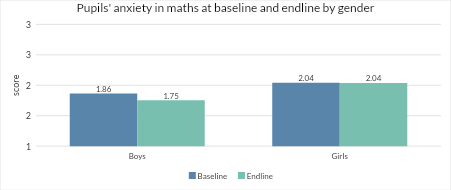
Figure 5. Pupils’ anxiety in maths at baseline and endline timepoints by gender (n=124 female pupils, n=114 male pupils).
In line with a reduction in maths anxiety, a few teachers explained that through Sumdog’s game-based learning pupils were able to see maths as less intimidating and more approachable. The teacher below suggests that through Sumdog, maths was seen less as a daunting subject but something pupils can engage with in a more relaxed and enjoyable way:
“And I think that's helped change, you know that maths… is not as tricky as perhaps it's been made out and it's not this great big ogre, you know, it can be done whilst you're still learning as well. So I think it's that sort of just that consolidation really that matters, and let's go and play on the computer.”
Teacher 10
Year 5 & 6 Teacher
Other teachers commented on various external motivators improving pupils’ feelings towards practicing maths, such as seeing their profile improving on the platform and ‘Sumdog’ moving across the screen when they answered correctly.
The findings suggest that pupils are highly engaged with and enjoy using Sumdog. However, while the evaluation aimed to measure changes in attitudes towards maths, these attitudes may be more deeply embedded and less likely to shift in the short-term. Teachers saw value in using Sumdog to keep all pupils, including those who struggle with or dislike maths, engaged in learning. They also expressed hope that sustained engagement over time could lead to more positive attitudes towards maths. The latter assumption would benefit from longer-term investigation. In light of male and not female pupils showing a statistically significant reduction in anxiety towards maths, it would also be interesting to explore potential gender differences in how pupils respond to Sumdog and how this may influence their attitudes towards maths.
To what extent does using Sumdog impact pupils' attitudes towards maths?
Pupils’ maths attainment scores showed a statistically significant improvement between Term 1 and Term 3. Teachers recognised that alongside high-quality teaching within schools, Sumdog supported improvements in pupils’ mathematical fluency, which helped consolidate their understanding and, in turn, freed up lesson time to focus on other areas of the maths curriculum.
It is also important to note that, as pupils are generally expected to show improvements in attainment over time due to teachers’ interventions, causation cannot be inferred without a comparison group. Investigating whether pupils with similar demographic characteristics who did not engage with Sumdog show similar or different progress would provide valuable context on the efficacy of Sumdog. Future evaluations could consider tracking the present cohort of pupils into Year group 6 and comparing their KS2 SATs results in maths to national averages.
Looking at the entire cohort of pupils, in Term 1, 38.9% of pupils were working below expected standard, 48.1% at expected standard and 13.0% above expected standard (Figure 6). In Term 3, 7.4% more pupils were working above expected standard compared to Term 1, and 6% fewer pupils were working below expected standard. This change is statistically significant (p=0.004).
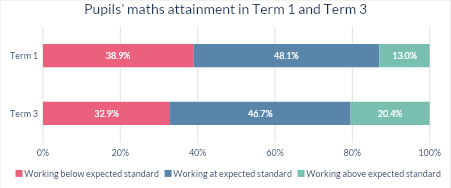
Figure 6. Pupils’ maths attainment in Term 1 and Term 3 (n=499).
Interestingly, pupils both with and without SEN made statistically significant improvements in their maths attainment (p = 0.004 and p < 0.001, respectively; Figure 7). Among pupils with SEN, 71.8% were working below the expected standard in Term 1—a figure that fell to 41.4% by Term 3. The proportion working at the expected standard nearly doubled over the same period, while the percentage achieving above the expected standard rose from 1.8% to 9.3%.
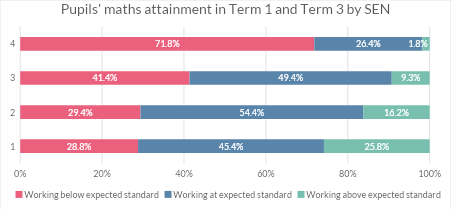
Figure 7. Pupils’ maths attainment in Term 1 and Term 3 by SEN (n=388 pupils without SEN, n=110 pupils with SEN).
The Supply Year 5 teacher highlighted the benefits of Sumdog for pupils with SEN, noting that they particularly enjoyed the activities. While acknowledging that Sumdog may not directly improve attainment, they emphasised its role in motivating pupils to practise more regularly – something they felt contributed to better understanding and, ultimately, progress.
“ So the ones that have special needs, they often do struggle with maths and sometimes I have to sit with them and…go over the questions a few times for them to understand…However, with Sumdog…these children… [say] “we want to do Sumdog, we want to do this activity.” And they're quite fast in that sense. So I feel like Sumdog has had a positive impact on especially SEN children because they want to do the…activities that are set on Sumdog.”
Teacher 15
Supply Year 5 Teacher
Only male pupils showed a statistically significant improvement in maths attainment, with a 10.8% increase in those working above the expected standard and a 7.4% decrease in those working below (p = 0.006; Figure 8).
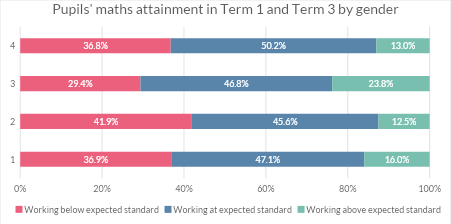
Figure 8. Pupils’ maths attainment in Term 1 and Term 3 by gender (n=246 female pupils, n=253 male pupils).
Teachers emphasised that high-quality teaching is central to improving maths attainment, while recognising Sumdog as a supportive practice tool that helps consolidate knowledge and may indirectly improve attainment. They also noted that attainment is shaped by multiple factors, including teaching quality, wider school strategies, and individual pupil needs. Reflecting this interdependence, one teacher observed:
“They have been progressing well…And whether that's down to Sumdog or my fantastic teacher, I don't know, but it's probably good teaching and external factors and different things like that. So it's good to see.”
Teacher 8
Assistant Headteacher
Others acknowledged improvements in areas like confidence and fluency, while still emphasising their own role in driving progress: "My role in that is very important as well, not just Sumdog" (Teacher 13, Year 4 teacher). A maths lead echoed this sentiment, describing Sumdog as “a tool that we can use to complement our teaching…a really good motivational tool,” but stressed that it should be seen as an addition to – not a replacement for – quality classroom instruction. He concluded that while the platform may support small gains, “it would be very, very difficult to prove or disprove the impact of Sumdog” on formal attainment outcomes (Teacher 12, Year 5 & 6).
Key Finding: School J
Teacher 12, who taught Year 5 and 6 and also served as Maths Lead, described Sumdog as a useful addition to the toolkit they have to use to drive up attainment and engagement amongst their pupils.
Other teachers highlighted the positive impact of Sumdog on pupils’ mathematical fluency. Teacher 8 observed that regular exposure to visual representations – such as part-whole and bar models through Sumdog – appeared to strengthen pupils' conceptual understanding. Without Sumdog, such representations often had to be introduced from scratch in the past, whereas with Sumdog, pupils showed greater confidence in applying them to solve problems.
“When we come back to doing things in White Rose, they just got that understanding of part [and] whole models, missing number problems…those kind of soft mathematical skills are really developing because they're exposed to these different visual representations all the time. It's not just a number…When I worked in a previous school without Sumdog, when we came to those visual representations, it was like first we have to almost re-teach those… So for example, today we did some bar models. And they just ’Yeah, no, I know how to draw this part. I've got to break this section up into three different parts’, and they're just familiar with those different…representations, which is good to see.”
Teacher 8
Assistant Headteacher
This suggests that Sumdog may help develop foundational, transferable mathematical skills that support wider curriculum learning.
A Year 5 teacher recognised improvements in pupil performance when using Sumdog but noted a disconnect between pupils' success on the platform and their outcomes in traditional, paper-based assessments. While digital activities may build confidence and fluency, the teacher highlighted the challenge of ensuring that this learning transfers effectively to formal test settings. This points to a broader issue around test technique and the need to support pupils in applying their knowledge across different formats – particularly those used in statutory assessments. It also reinforces the importance of a quality-first teaching approach as suggested by Teacher 12 above, where digital tools like Sumdog are used to complement, rather than replace, strong classroom instruction that helps pupils consolidate and apply their learning in a range of contexts.
“With my class, we've seen progress, we've seen improvements. What I am seeing is a bit like what you were saying. I see on the computer, but I don't necessarily see it in the tests that they do pen and paper at the desks. So it's about…getting them to apply what they're doing on the computer.”
Teacher 11
Year 5 Teacher
Findings suggest that pupils using Sumdog saw statistically significant improvements in maths attainment between Term 1 and Term 3, particularly among pupils with and without SEN, and male pupils. However, as pupils are generally expected to show improvements in attainment over time due to teachers’ interventions, causation cannot be inferred without a comparison group. Teachers emphasised the role of high-quality teaching as the primary driver of attainment progress, viewing Sumdog as a useful addition to the toolkit they have to use to drive up attainment and engagement amongst their pupils. Notably, several teachers noted Sumdog’s positive impact on mathematical fluency.
Is there any differential impact on pupils eligible for Pupil Premium or with SEN status?
Focus group discussions revealed that pupils with SEN, lower-attaining pupils and pupils with lower self-esteem were the ones mostly benefiting from the use of Sumdog. Often pupils had all three (SEN, lower grades and lower self-esteem). One feature of Sumdog was highlighted by teachers in helping improve pupil outcomes in maths: Sumdog matching the questions’ difficulty to the ability of pupils. This way, the lower-attaining pupils are able to participate and engage at the same level as the rest of the class without feeling inferior.
Teachers explained that because of Sumdog they were able to look at where the learning of pupils with SEN was and step it back if necessary. A teacher described that pupils who had been struggling in class would feel like they were not succeeding in lessons. Using Sumdog, the teacher was able to set the sessions at a level that would enable pupils to succeed and get rewarded as a result, improving their self-esteem. They gave an example of one of their pupils:
“One of the children who I'm thinking of particularly…is a Year 4 girl who's probably operating at Year 1 level. So we're having to significantly differentiate the work which she's doing within her sort of group…even then it feels to her that she just doesn't understand, doesn't get it. But when we can then put work in front of her with Sumdog to let her know that yes, she can succeed, her face lights up because she knows she can do it at that point.”
Teacher 4
Maths Lead & Year 4 Teacher
Another teacher expanded on this idea, highlighting that Sumdog provided opportunities for a wider range of pupils to succeed and build confidence through positive experiences. They noted that, when reviewing Sumdog scores, a pupil who typically performed less well in class was achieving high scores on the platform:
“It says it's…in the top five. When perhaps you don't feel that if we were setting [tasks] at school…you wouldn't necessarily be in the top group. It's nice to. It's just nice to shine, isn't it? In something. And…that is an element I didn't really expect.”
Teacher 14
Maths Lead
In addition to the confidence of getting rewarded for getting maths answers right, Teacher 3 explained the benefit of being able to participate in the class’s activities without feeling like their classmates’ exercises were different:
“So they're able to join in as a whole class while doing the questions. And obviously the children [not performing at expected standard] don't know that is different based on their ability. But because they see everybody playing on Sumdog together, they just assume that…they're doing the questions together. And it's quite, really nice.”
Teacher 3
Year 5 Teacher
All of the teachers interviewed spoke positively about Sumdog’s ability to allow pupils to work at different levels within the same activity, without being aware of those differences (Figure 9).
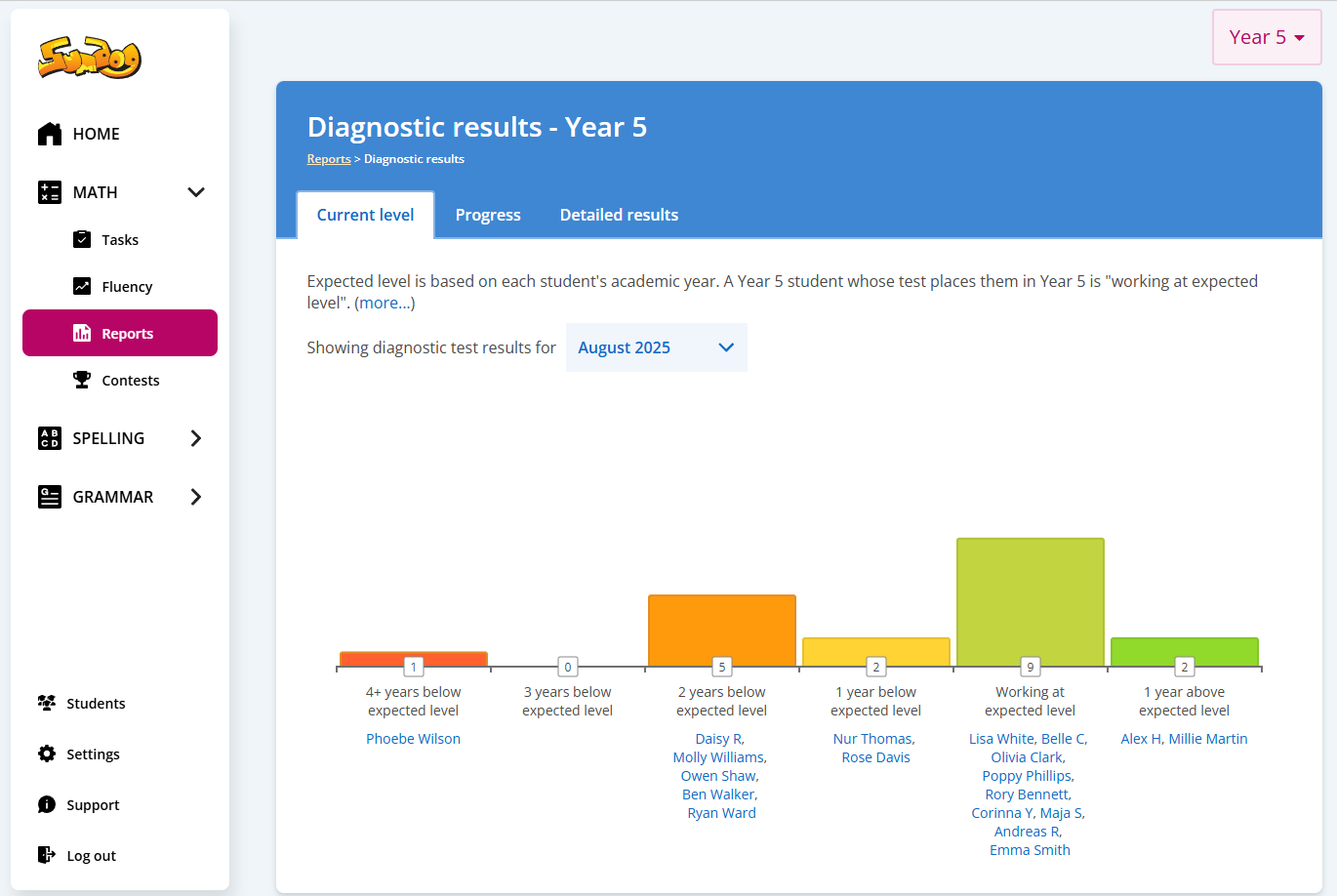
Figure 9. Diagnostic results for pupils working at different levels on Sumdog
Another benefit of Sumdog’s platform is that it can be accessed from home or anywhere with an internet connection. This means that pupils who are unable to attend school – whether due to holidays or more serious reasons – can continue engaging with their learning and either keep up with their peers or catch up in their own time. Teacher 10 shared an example of this in practice:
“Unfortunately, this year I've had a couple of children who've had, say, one lad’s recently been diagnosed epileptic and I've got another young lady who's gotten overactive and there’s something wrong with her thyroid…So they've both had quite a bit of time off school because of various [reasons]. I was able then to use Sumdog…they might not have been in my lessons, but they're still covering things that we were covering in school.”
Teacher 10
Year 5 & 6 Teacher
Finally, teachers noted that the fun, game-based element of Sumdog helped re-engage pupils who might otherwise be reluctant to participate in maths. Teacher 6 shared that their SEN pupils were particularly enthusiastic, viewing it as a game rather than a traditional lesson —making them more eager to take part:
“They all [six children with SEN] have the same attitude as in I don't like maths…I don't ever want to do it. But then once I say, Oh no, we're getting Sumdog, they're like, oh, OK, then we'll do it then…it's helped [them]…more than any of my other children in the class”
Teacher 6
Year 5 Teacher
Similarly, Teacher 11 talked about a pupil with autism who found the time limits in teacher assessments stressful, leading him to avoid the tests. To reduce anxiety, the teacher encouraged him to focus only on Sumdog games, which offered a more manageable way to engage with maths. Despite some ongoing anxiety, the pupil still benefited from this flexible approach.
“We do have one little boy who's autistic, who's really struggling with the…time…and he doesn't like doing any of the tests because he…gets stressed that there's a time limit and stuff. So we've just said to him, why don't you just play the games, ignore the tests and we'll see how you get on and he's still benefited from it…he's still very anxious about the whole time thing.”
Teacher 11
Year 5 Teacher
It is worth noting that timers can be turned off, giving teachers greater flexibility in how they use Sumdog with pupils.
Teacher 5 mentioned that, in their experience, specifically boys with low self-esteem benefited most from using Sumdog. They explained that this subgroup of pupils who had an external examination for the first time at the end of Year 4 and had had a low grade, entered Year 5 with lower self-esteem. Sumdog was a way of getting them engaged again with maths (Figure 10):
“Because they [low self-esteem boys] will know that they didn't pass their Year 4 timetable check… I think coming into Year 5…that can have given them quite a blow…So this ‘we get to play games to do our maths’ has been our step forward with them. So it's nice to see them keen and talking about maths again.”
Teacher 5
Maths Lead & Year 1 - 6 Teacher

Figure 10. Example of a game on Sumdog
Despite pupils with SEN, lower-attaining pupils and those with lower self-esteem being those that seemed to benefit most from using Sumdog, Teacher 3 mentioned their concern about those pupils struggling to understand some of the questions because of the way in which they were worded and finding the existence of a timer during the exercise too stressful (e.g. “I don't know if there's a way to turn the times off for him or something. I haven't actually explored that yet”, Teacher 11, Year 5 Teacher).
It is important for Sumdog to remain mindful of the individual differences of pupils in these subgroups in order to keep serving them appropriately. It is noteworthy that Sumdog is already working to support children who find the timed nature of the games stressful by providing 21 games without this feature within the questions for children to choose.
Pupils with SEN, lower-attaining pupils, and those with lower self-esteem – often overlapping groups – appeared to benefit most from using Sumdog. A key feature contributing to this was the platform’s ability to automatically adjust to each pupil’s level, while maintaining the appearance that all pupils were playing the same game. This helped reduce feelings of difference or stigma and allowed these pupils to engage meaningfully with maths exercises.
According to teachers, were there any pros and cons to using Sumdog?
8.1 Easy platform to learn and use
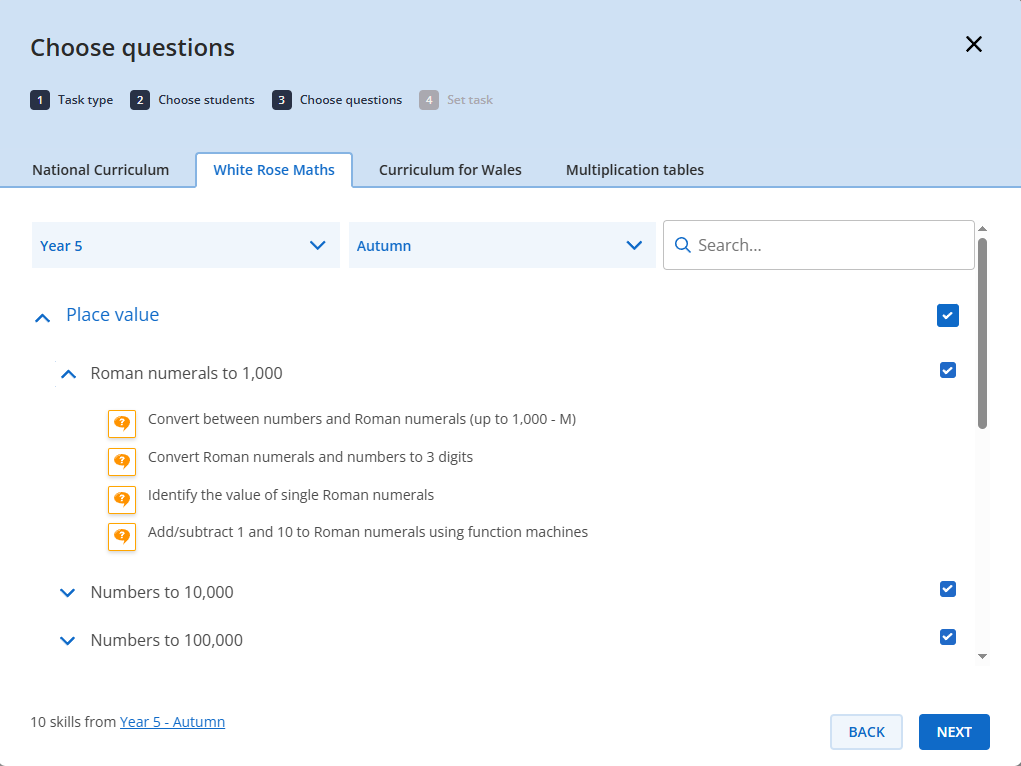
Teachers mentioned that the platform was easy to learn and use. Teachers explained that after the initial induction and setting up they didn’t need further help. They also appreciated that the exercises on Sumdog were aligned with the national curriculum for maths and the White Rose Maths schemes of learning for Year 1-6 which made matching the Sumdog exercises with the lessons easier. Interestingly, teachers noted that pupils also understood how to use the platform with ease.
Teachers gave a variety of examples describing features that made the learning and the use of the platform easy. Overall, they mentioned that post-training, they didn’t need further support and that it was easy to set up homework for the entire class but also to differentiate it for some pupils. They also found it easy to interrogate pupils’ level of understanding through the data on the platform. The comments can be summarised in the following statement:
“… But the set-up and the usage…it's been so straightforward from my experience, I haven't really needed that much communication.”
Teacher 5
Maths Lead & Year 1 - 6 Teacher
A number of teachers mentioned the convenience of Sumdog exercises mapping onto the national curriculum and White Rose Maths schemes of learning (Figure 11). This enabled them to quickly and efficiently assign exercises to pupils based on the curriculum they are using in school, but also ensure that these exercises are in line with what the pupils had learned in class. The teacher below explains their experience of the two marrying up:
“So… we use the White Rose scheme, so it [Sumdog] actually marries up then to what the questions are that White Rose uses. So [the pupils] can understand what is being said and what terminology is being used as well, which really helps.”
Teacher 6
Year 5 Teacher

Figure 11. Sumdog mapping onto White Rose Maths and the National Curriculum
In addition to the convenience of similar terminology between the curriculum and Sumdog, Teacher 10 also appreciated the convenience of being able to use Sumdog’s digital assessments at the end of a unit. This not only reduced the need for printing but also provided a quick and engaging way to assess pupils' understanding, making it a useful complementary tool for staff.

“We follow White Rose in this school and White Rose is great but…their assessments are always paper-based…The staff are enjoying the fact that at the end of the unit, instead of having to…print off reams of paper, they can set a little test for the kids and the children can go in and they can use it as an assessment tool.”
Teacher 10
Year 5 & 6 Teacher
Teachers also described the set-up of Sumdog as intuitive and the relief they have felt since other teachers within the school haven’t raised any issues about using Sumdog. They explained the importance of a new software not creating more issues for teachers. For example:
“At this point I'm more excited that the staff have not come back to me saying it's caused them any headache or any workload because that was the deal.”
Teacher 4
Maths Lead & Year 4 Teacher
This was reflected, in the comparison Teacher 8 made between other programmes they had used in the past and Sumdog:
“I've used some education programmes, for example [Name of programme] and it is the most convoluted, most complicated system and user interface that you've ever used. You can never find what you're looking for, whereas it [Sumdog] is actually so easy as a teacher you know, let alone for the children…to actually go. Right? Well, I want to see how this student is performing, you can find that instantly or if I want to set a task it's done in what? 30 seconds?”
Teacher 8
Assistant Headteacher
On a similar note to the quote above, teachers felt very positive about pupils learning quickly how to use Sumdog. They mentioned that once pupils had been shown how to do something on the platform, they wouldn’t need further support with it. Teachers’ thoughts can be summarised through the quote below:
“So when I first started doing the homework, they're like, miss, I can't, I don't know where the homework is. And I was like, no, if I just show you…I went onto one of their accounts and then showing them all then…now…none of them asked me. They're all just like, Oh, we know where it is now…So I think it's it's a very easy program for the children to use in the sense of it's very child-friendly so that they can use it by themselves instead of always having someone with them trying to re-explain how to use something.”
Teacher 6
Year 5 Teacher
8.2 A risk of some pupils being more focused on winning against their classmates than learning
The teachers talked about how the gamification of learning maths through Sumdog led to pupils’ higher engagement. They mentioned that through competitions among pupils from the same class or different classes, pupils would get motivated to complete the exercises and finish their homework.
“…So it's quite nice to see that actually, because there's some element of competition there that the children are like, Oh…I'm going to make sure that I'm better than what you're doing.”
Teacher 6
Year 5 Teacher
A couple of teachers expressed a concern about pupils not always using their mathematical knowledge to get the answers right. They explained that pupils at times were trying to be as fast as they could as part of the game in order to try and beat their friends. For that reason, a teacher explained that at the moment their school was going through a process of getting pupils to settle with the change, and realise the importance of getting the answers right as a result of their mathematical knowledge and fluency. Teacher 6 explained their experience:
“They're just like, oh, but I need to beat them. I need to be as fast as I can…So I'm actually having to…put stuff in place and be like, if I see that you get 80% and above on your maths, then I will use like the school system…there's a tracking point and stuff like that.”
Teacher 6
Year 5 Teacher
Teacher 4 alluded to the fact that a reason for pupils being prone to focusing more on getting answers right and quickly rather than learning is the multiple-choice format of answers. They explained that their pupils wouldn’t always give enough thought to the options and would select the answers again and again until they got to the right one:
“The multiple-choice option is not helpful because some of the children just keep going and you can click and re-click until you get the one that's right. So therefore those children that would have been more accurate and thoughtful maybe are not being as accurate as they would be because they see other people who they know are maybe not as able at that skill frantically banging on buttons and moving forward with the task.”
Teacher 4
Maths Lead & Year 4 Teacher
To help children avoid rushing through to get to the gaming part, in May 2025 Sumdog launched new 'Don't rush' prompts along with collectible rewards and feedback on pupil accuracy (Figure 12). Indeed, one of the teachers observed this feature and noted that it was useful for slowing down especially some of their male pupils:
“I like the bit that was brought in just this week where if they're doing things too fast or…I only found it this week, it slows them down…We found that really useful as well… particularly [for] the boys who want to get through quickly.”
Teacher 10
Year 5 & 6 Teacher

Figure 12. Sumdog’s anti-rush system
This was also observed by another teacher who mentioned the warning received on the teachers’ side if the pupils are answering a number of answers wrong in a short amount of time:
“… I've got a couple of children in my class who… are getting very low accuracy, but very high numbers of questions and they're just trying to whip through the questions, get them done and then get back to the game that they're enjoying. So that's something that Sumdog appears to have sort of realised and then put something in place because it will give you as a teacher a little flag if someone's…taking long enough or just getting lots and lots of answers wrong in a very short amount of time.”
Teacher 13
Year 4 Maths Teacher
Since the study commenced, Sumdog has also given teachers the ability to turn off the multiplayer games and for children to be diverted to a non-game part of Sumdog if they continue to rush through answering questions.
On a positive note, Teacher 6 found that after explaining to pupils that they might perform better if they actually know the answers to the questions, they engaged more meaningfully with the exercises:
“Once I properly explain to them and I'm like, you will get more points if you actually score the answer right first time. And like I do say it that way. And they're like, oh really? And I'm like, yes, really…they have started to actually sit in there and actually be like, no, I actually do need to work it out.”
Teacher 6
Year 5 Teacher
Overall, teachers mentioned the ease of learning and use of the platform as one of the biggest strengths of Sumdog. While the gamified approach to maths boosted pupil engagement, some teachers noted that pupils tended to prioritise speed over accuracy, especially when competing against friends. However, a recent feature introduced by Sumdog – prompting pupils to slow down – appears to be effective in encouraging pupils to apply their mathematical understanding more carefully when answering questions.
Summary and Next Steps
Sumdog is an adaptive learning platform for pupils aged 5 to 14 years old providing a range of tasks and low-stakes tests to help them practise maths. On Sumdog, children consolidate prior knowledge through answering curriculum-aligned questions integrated into fun gameplay. At the same time, pupils’ teachers can identify gaps through automated reports and demonstrate pupil progress.
This impact report draws on data collected during the 2024–25 academic year, including pupil surveys, maths attainment data, and insights from teacher interviews and focus groups. It explores how Sumdog was implemented in schools and examines its impact on pupils’ attitudes towards maths and their teacher-assessed attainment outcomes.
Overall, teachers found a variety of uses for the Sumdog platform. They used it as a practice tool for consolidating learning in class but also at home. Due to its element of gamified maths exercises, many teachers were also able to engage those pupils that would usually be less likely to engage. Finally, they were able to identify pupils’ gaps at a year group level, but also at an individual-level for classroom teachers engaging with the platform.
The findings suggest that while participating pupils’ engagement with and enjoyment of maths through Sumdog increased, their broader attitudes toward maths as a subject were not necessarily shifted. More specifically, pupils’ confidence in maths, their motivation, and perceived capability did not significantly change according to the self-reported surveys. Interestingly, there was a statistically significant 5.5 percentage point decrease in maths anxiety among male pupils. This reduction may be partly explained by their tendency to engage more positively with competitive features in the learning environment. Teachers saw value in using Sumdog to keep all pupils, including those who struggle with or dislike maths, engaged in learning. They also expressed hope that sustained engagement over time could lead to more positive attitudes towards maths.
Pupils saw statistically significant improvements in maths between Term 1 and Term 3, however teachers were cautious about attributing these gains solely to Sumdog. Findings suggest that pupils using Sumdog experienced statistically significant improvements in maths attainment between Term 1 and Term 3, particularly among pupils with and without SEN, and male pupils. Teachers emphasised the need to have a toolkit of strategies to drive pupil progress, of which Sumdog was a valuable component. While teachers generally recognised its value in motivating pupils and enhancing engagement, some also noted Sumdog’s positive impact on mathematical fluency. This suggests that Sumdog may contribute to the development of mathematical skills that complement classroom learning.
Pupils with SEN, lower-attaining pupils, and those with lower self-esteem – often overlapping groups – appeared to benefit most from using Sumdog. A key feature contributing to this was the platform’s ability to automatically adjust to each pupil’s level, while maintaining the appearance that all pupils were playing the same game. This helped reduce feelings of difference or stigma and allowed these pupils to engage meaningfully with maths exercises.
Male pupils’ maths progress emerged as a notable trend across the findings. They showed a statistically significant decrease in maths anxiety, alongside a statistically significant improvement in attainment between Term 1 and Term 3. Several teachers also observed that lower-attaining boys appeared to benefit the most from using Sumdog. These findings suggest that gender may play a role in how pupils engage with and respond to the platform. Exploring these gender differences in both uptake and impact could be a valuable focus for future research.
Overall, teachers mentioned the ease of learning and use of the platform as one of the biggest strengths of Sumdog. A number of teachers also mentioned the convenience of Sumdog exercises mapping onto the national curriculum and White Rose Maths schemes of learning. While the gamified approach to maths boosted pupil engagement, some teachers noted that pupils tended to prioritise speed over accuracy, especially when competing against friends. However, a recent feature introduced by Sumdog – prompting pupils to slow down – appears to be effective in encouraging pupils to apply their mathematical understanding more carefully when answering questions.
9.1 Next steps for the evalutation
- Longer-term investigation of pupils’ attitudes alongside the introduction of a comparison group. Given teachers’ views that sustained engagement with Sumdog may lead to more positive attitudes towards maths, this assumption would benefit from further investigation over a longer period. Together with this, future evaluations could consider tracking participating pupils from this evaluation into Year group 6 and comparing their KS2 SATs results in maths to national averages.
- Exploration of gender differences. In light of male and not female pupils showing a statistically significant reduction in anxiety towards maths, it would also be interesting to explore potential gender differences in how pupils respond to Sumdog and how this may influence their attitudes towards maths.
- Including pupil interviews as a next step in the evaluation would be valuable to capture the perspectives of the direct beneficiaries – not only in terms of their experiences with Sumdog, but also how their attitudes toward maths may have progressed after using the platform over time.
Contributors:
Anthony Grower
Topic Specialist
Kelly Brighton
Topic Specialist
Richard Peace
Topic Specialist
Sources:
From Our Blog
Stay up to date with what is new in our industry, learn more about the upcoming products and events.

Festive Worksheets For Classroom and Home Learning
-2.png)
Hear From Our Schools: Mark Hyslop, Nether Robertland, East Ayrshire
